Sharing · Essential oils
Essential oil safety: the tips I took from the book
I enjoy essential oils as a hobby, so I wanted to know how to use them without hurting anyone, including myself. The book most professionals point to is Essential Oil Safety by Robert Tisserand and Rodney Young, a long, careful reference written for health care professionals.
These are the tips I took from it, written in my own words. I am not an aromatherapist, and nothing here is health advice: I use oils for scent. If something on this page and the book ever disagree, trust the book.
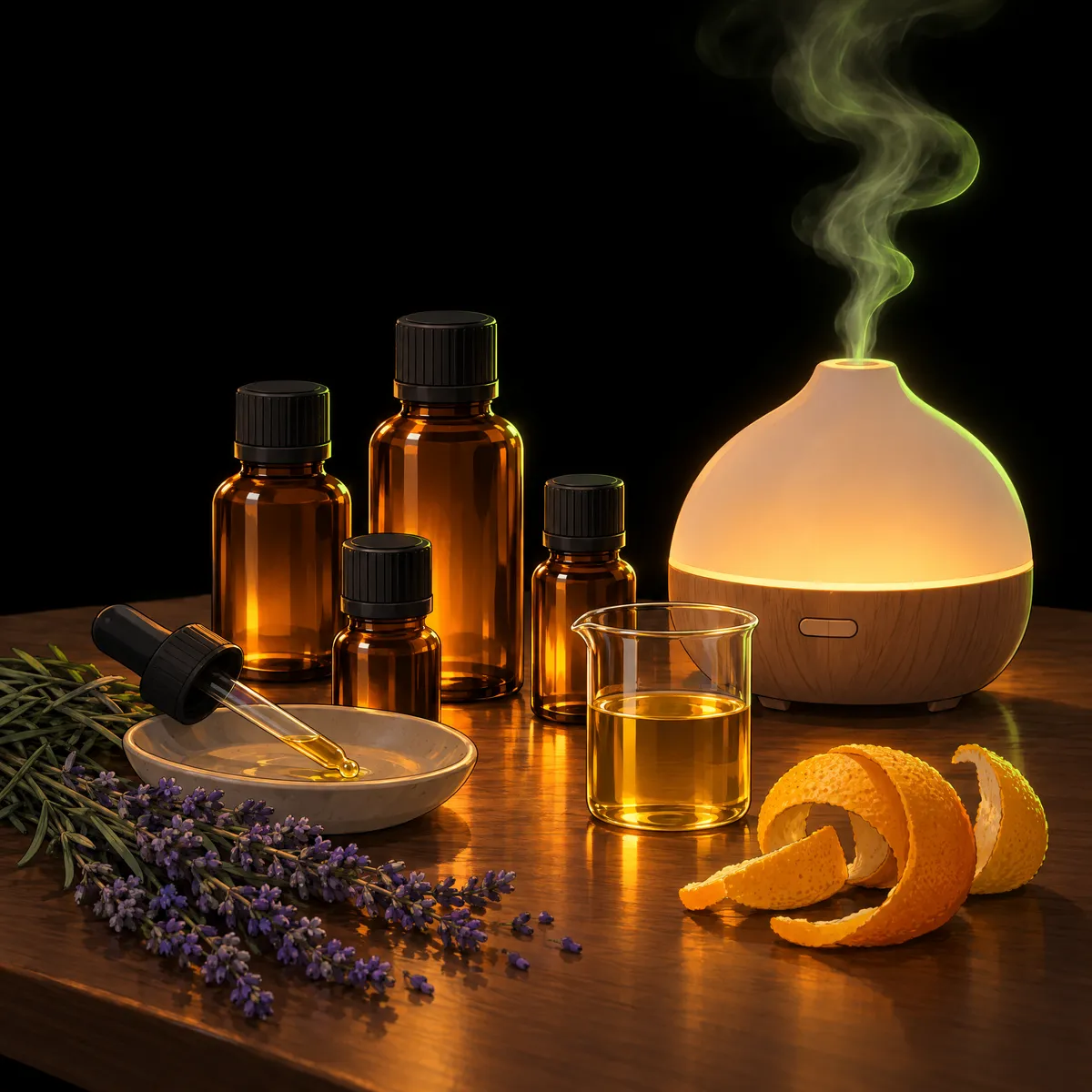
Keep diffuser sessions short, and let some air in
A few drops in a diffuser is about as low-risk as essential oils get. The trouble starts with long exposure to strong vapour: the book links more than about half an hour of it to headaches, dizziness and nausea.
So I run the diffuser for around 30 minutes, then switch it off for a while, and I keep a window or door open a little. The blends I share use about 6 drops per 100 ml of water, and a faint scent is the goal.
Dilute before oil touches skin
Undiluted essential oils are not meant for skin. For a large area of adult skin, the book gives 2 to 3% as typical and 5% as the most, in a carrier oil such as sweet almond. A drop is roughly 1/30 of a millilitre, though droppers vary from about 20 to 40 drops per millilitre, so treat these as close guides.
Roughly how many drops of essential oil Dilution In 10 ml carrier oil In 30 ml carrier oil 1% 3 drops 9 drops 2% 6 drops 18 drops 3% 9 drops 27 drops Use far less on children’s skin
Young skin is thinner and takes in more, so the book’s suggested strengths drop sharply with age. It is careful to call them helpful suggestions rather than rules.
Suggested and maximum strength on skin, by age Age Suggested Maximum Premature babies none none Up to 3 months 0.1% 0.2% 3 to 24 months 0.25% 0.5% 2 to 6 years 1% 2% 6 to 15 years 1.5% 3% 15 and over 2.5% 5% Around children, leave out eucalyptus, rosemary and peppermint
Oils rich in 1,8-cineole, such as eucalyptus and some rosemary, and menthol-rich peppermint have caused serious breathing problems in small children, mostly when put in or near the nose. The book says to keep them off and away from a child’s face.
For children of 5 and under, it also advises against breathing oil directly, from hands, a tissue, an inhaler or a bowl of hot water. A diffuser across the room is the gentler way, and for premature babies the book suggests skipping even that.
Never swallow oils, and keep bottles out of reach
The book is blunt about this: most accidents with essential oils involve young children, and the small 5 to 15 ml bottles oils are usually sold in can be enough to seriously poison a child who drinks one. In one Australian report it cites, most of the young children poisoned by eucalyptus oil had drunk oil meant for a vaporiser, and most of them were between 1 and 3.
I keep bottles closed and up high, and the book recommends child-resistant caps where you can get them. I do not take oils by mouth, and I would not suggest anyone else does without a qualified professional.
Some citrus oils and sunlight do not mix on skin
Certain cold-pressed citrus oils can burn skin that meets sunlight or a sunbed afterwards, sometimes badly. The book lists the most a product should contain to avoid this, and the 12-hour gap to keep if you go above it.
This only matters for oil left on the skin. Diffusing citrus oils, or using them in a wash-off soap, carries no such risk. Sweet orange, mandarin, tangerine, distilled lemon and bergamot labelled FCF (bergapten-free) are not phototoxic.
Most on skin before sunlight becomes a risk Oil Most on skin Bergamot 0.4% Lime (cold-pressed) 0.7% Bitter orange (cold-pressed) 1.25% Lemon (cold-pressed) 2% Grapefruit 4% Above these levels, keep the skin out of sunlight and sunbeds for 12 hours.
Oils go off: store them cool, closed and dark
Air, heat and light slowly change essential oils, and some become more likely to cause a skin allergy as they age. Citrus oils, pine, tea tree and most frankincense change fastest.
- Close the cap straight after use, and keep bottles somewhere cool and dark (the book suggests the fridge).
- Use citrus, pine, tea tree and frankincense within about six months of opening, or when the bottle is nearly empty.
- Use other oils within about a year of buying or opening, unless the label gives a date.
If you have asthma, keep the scent faint
Essential oils are not a common cause of breathing problems, but any strong scent can set off asthma or fragrance sensitivity. The book’s advice is to keep scent in the air low, with good ventilation and not-too-dry air.
One detail I did not expect: some airborne oil molecules react with ozone to form irritants, so it is better not to diffuse right beside an ozone-producing air purifier or a laser printer.
Oils burn: keep them away from flames
Many essential oils have flash points of only 50 to 60 °C, so their vapour can ignite near a flame. I keep bottles away from candles and never leave a flame burner unattended.
The book also notes that towels with oil left in them have caught fire on their own in a tumble dryer, so wash oily cloths at 40 °C or more before drying them.
Give pets a way out of the room
This one is my own caution rather than something from the book: animals cannot tell you when a scent is too much. I leave a door open so pets can leave, and I am extra careful with cats.
Pregnant, breastfeeding or on medication? Ask first
The book lists a number of oils to avoid in pregnancy, and notes that oil constituents can pass into breast milk. Some oils can also interact with medicines, mainly when taken by mouth. If any of these apply to you, ask a doctor or pharmacist before using oils, even in a diffuser.
If something goes wrong
The book’s first aid steps, in short:
- Oil in the eyes: rinse with plenty of water for at least 15 minutes, holding the eyelids open. Take out contact lenses after the first 5 minutes. Get medical advice if the irritation does not settle.
- Oil on the skin causing a reaction: wash gently with unperfumed soap and water for at least 10 minutes, and keep the skin out of direct sunlight.
- Too much vapour: move to fresh air.
- Swallowed: do not make the person vomit. If they are awake, rinse their mouth with water and call a hospital or poison centre straight away.
Buy oils that tell you what they are
A good label gives the plant’s botanical name, the part of the plant used and a use-by date, and the book warns that adulteration is common. I would rather buy from a supplier who can show those details than from the cheapest listing.
For businesses sourcing essential oils and carrier oils in Malaysia, I work with FC Materials, who supply both.
Where these tips come from
Robert Tisserand and Rodney Young, Essential Oil Safety: A Guide for Health Care Professionals, 2nd edition (Churchill Livingstone, 2014). The figures above are the book’s; the wording is mine. If you use oils on other people, or for anything beyond scent, the book itself is worth reading in full.
Next: try the diffuser blends I share, which are mixed with these tips in mind, or mix your own in the Blend Lab.